Industry SolutionsPricingGetting StartedResourcesAbout UsFAQ
Contact Us

HolePlan™ is a trademark of Hole Plan Ltd. All software code and 3D visualisation logic are protected under the International Copyright Law. This software is an independent engineering tool and is not affiliated with any hardware manufacturer.

Our Office

Mladost 2, Bl. 221, Ent. 1, Floor 9, Apt. 41

Sofia Municipality, Mladost District

Sofia 1799, Bulgaria

Resources

    Drilling intelligence without bordersValidation of Mathematical AccuracyBorehole Safety & Risk MitigationPress & Media

Support

    SupportTerms and ConditionsPrivacy Policy

Company

    IntroductionAbout UsContact Us
Copyright © 2026HolePlan
CDDA
ADIA
All resources

When the rig and office change the same hole

Cloud-connected drilling software promises to keep field and office teams working from the same information. The harder question is what happens when the internet drops out, both sides keep working and their versions no longer agree.

By Jamie Wade
Australasian Drilling, October–November 2026

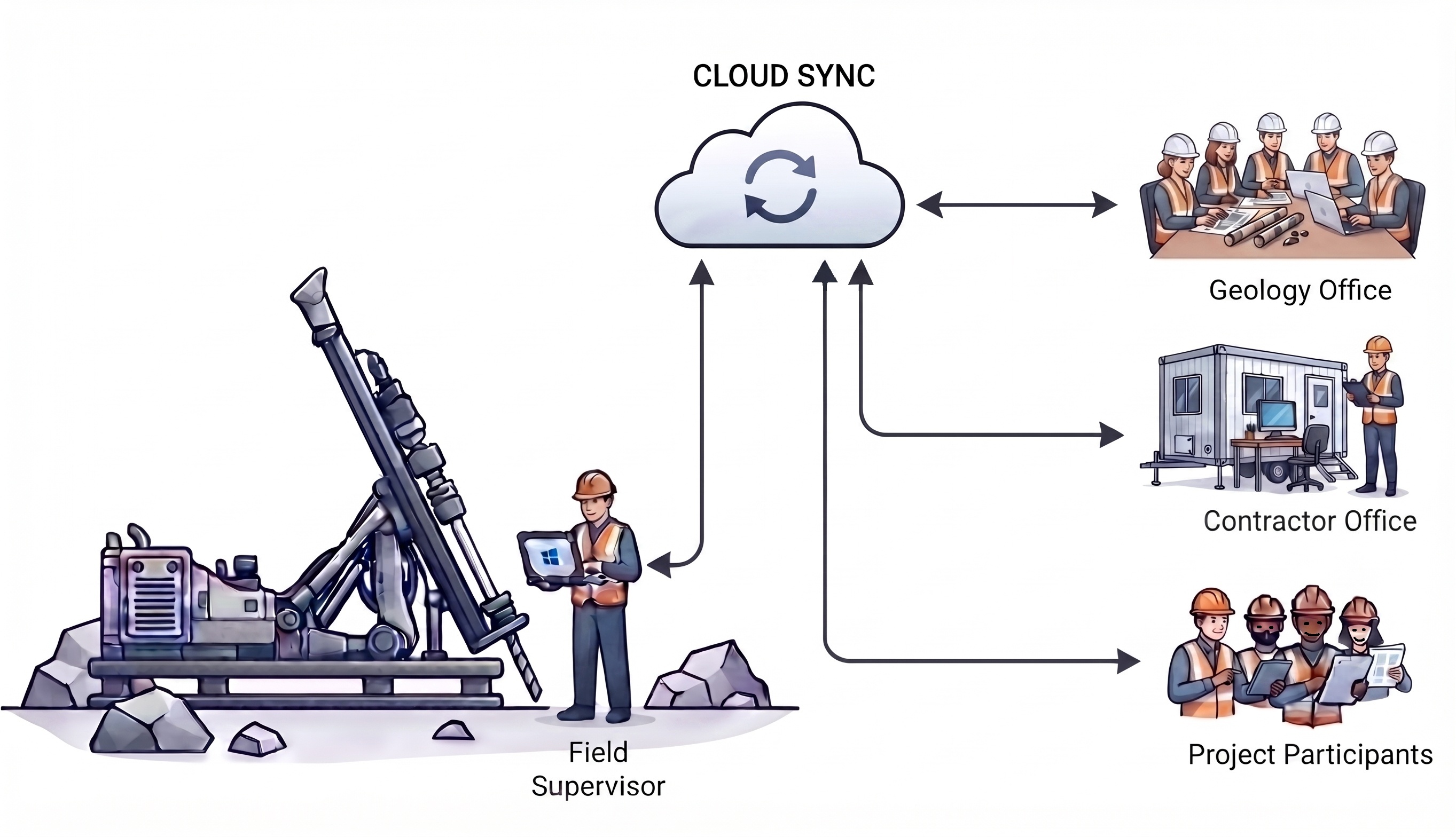
HolePlan Cloud Sync is designed to keep rig, drilling contractor office, geology office and other authorised project participants working from synchronised project information, while allowing the rig-side application to continue operating offline. Image: HolePlan.

HolePlan Cloud Sync is designed to keep rig, drilling contractor office, geology office and other authorised project participants working from synchronised project information, while allowing the rig-side application to continue operating offline. Image: HolePlan.

Remote drilling has never been particularly interested in what the internet thinks it should be doing.

Connections drop out. Bandwidth gets squeezed. A rig can be hundreds of kilometres from the people planning the next hole, while survey information, trajectories and project changes continue accumulating in the field.

The traditional workaround is familiar: local files, email attachments, shared folders and copies passed between field and office.

It works, until there are two "current" versions.

HolePlan CEO Ivan Dimitrov says that problem was central to the development of Cloud Sync, which connects users across drilling sites, contractor offices and geology teams while allowing the desktop application to keep operating without an internet connection.

Founded in 2026 by a team combining directional drilling and software engineering experience, HolePlan develops desktop software for borehole planning and monitoring. It covers trajectory planning, 3D visualisation, survey data management and directional drilling analysis, with downhole information tracked throughout a hole’s life, including lithology, wedges and cement plugs. Cloud Sync carries that work between rig and office.

Ivan says active users include Priority Drilling in Europe, Target Directional in South America and Global Drill across Asia-Pacific and Africa, alongside geologists and drilling supervisors trialling the platform.

That early field use is also feeding back into development. Ivan says the company works closely with users to turn practical feedback into product changes and new features in subsequent updates.

"The application is offline-first, so all core functionalities remain fully available regardless of whether the user is online or offline," Ivan said.

"A network connection is only required for cloud-related operations, such as synchronising data with the cloud."

That distinction matters in drilling.

A system that relies on permanent connectivity may work in an office. It is less useful beside a rig once communications disappear.


Keep drilling

HolePlan says there is no fixed maximum period for offline operation.

Users can work locally for extended periods and synchronise when connectivity returns.

At the rig, HolePlan runs on a Windows PC or laptop. Users can update project information, enter or import survey data, calculate directional drilling corrections and continue normal workflows offline.

Once a connection is restored, the software transfers changes made since the last successful synchronisation rather than uploading the entire project again.

The cloud provides the shared project state while local copies let users keep working in the field. Synchronised data also reduces reliance on a single field computer and can be accessed by authorised users from multiple locations.

For remote operations, that has a second benefit: bandwidth.

HolePlan estimates a typical day involving hole edits and survey updates would generate an incremental sync payload of around 0.5 to 2 MB.

The exact volume varies with the number of holes, survey points and other changes, but remains relevant for operations using constrained mobile or satellite links.

"The important point for remote operations is that HolePlan does not re-upload the entire project during synchronisation," Ivan said. "Only changes made since the last successful sync are transferred."

When versions collide

Getting files from a rig to an office is not the difficult part.

The harder problem arises when both sides change the same project while disconnected.

Imagine a supervisor at the rig and someone in the office changing the same hole data.

When the two machines reconnect, which version wins?

HolePlan deliberately avoids a simple "last write wins" approach.

If different information has been changed, the updates synchronise automatically and the event is recorded in an audit trail.

If the same information has been changed differently, however, the system identifies the conflict and presents it to the user rather than silently overwriting one version.

“Non-conflicting changes are synchronised automatically, so manual intervention is only needed when the system detects a genuine conflict.”

Ivan Dimitrov, HolePlan CEO

Ivan Dimitrov, HolePlan CEO

The user can review the discrepancy and retain the cloud version or reapply the local change.

For drilling contractors, that may be more important than the word "cloud".

Version control can become an operational and QA issue when survey information, planned trajectories or other project data moves between locations.

Flagging a conflict lets users make a deliberate decision rather than discover later that somebody’s work has disappeared.

The accompanying audit trail also provides visibility over what synchronised automatically and what required intervention.

Keeping clients apart

Another practical question for contractors is access.

A drilling company may work for several principals at once, with different crews, supervisors and office staff on each job.

HolePlan says multiple client projects can be managed within the same organisational environment while access is separated at project level.

Project admins decide who is invited into each project.

That means someone working on one principal’s project does not automatically gain access to another client’s project data.

Project roles and permissions are now fully available, allowing project admins to assign specific roles, such as admin, editor, or viewer and further customise permissions for each user within a project. Self-service administration is also fully supported.

Open by design

Rather than locking users into rigid proprietary pipelines, HolePlan uses file-based exchange supporting standard industry formats such as XLSX, CSV, DXF and JSON. That flexibility starts at the rig, where survey information can be brought in from north-seeking gyros, magnetic tools and other survey systems used in the field. For contractors working with platforms such as acQuire, Micromine, Leapfrog or Deswik, data exchange remains file based rather than a native live connection.

The company says it is also exploring integration options as customer demand develops.

Security and procurement

Moving operational drilling information into the cloud naturally raises another question: where does the data go?

Cloud Sync runs on Google Cloud infrastructure. Communication between the application and cloud services uses HTTPS/TLS encryption, while stored data is encrypted at rest on Google’s infrastructure. Access to project data is controlled per user and per project, and the audit trail records what was synchronised, when and by whom.

Authentication is handled through a managed identity service built on industry-standard protocols.

The useful part is what happens offline

The appeal of connected drilling software is easy to describe: everybody sees the same project.

The difficult part is delivering that when the field does not stay connected.

For drilling contractors, Cloud Sync’s more interesting features sit behind the marketing language.

The rig can keep working without internet. Synchronisation transfers incremental changes rather than entire projects. Separate clients can be isolated at project level. And when the rig and office disagree about the same information, the software does not quietly choose a winner.

It asks.

That may be the part drilling professionals appreciate most.

In an industry where the correct version of a hole plan, survey or project file matters, knowing a conflict exists can be as valuable as synchronising the data itself.

Originally published in Australasian Drilling, October–November 2026 (page 90). Read the original article on Flipsnack ↗